Flipkart DOD

Thursday, 10 January 2013

DMK succession row


 DMK succession row 


The renewed succession row in the DMK has cast a shadow on the birthday celebrations of the party's most prominent woman face and the patriarch's favourite daughter, Kanimozhi, who turned 45 on Saturday.

While her father and half brother M. K. Stalin - the heir apparent - greeted her in person early in the morning, Union minister M. K. Alagiri was absent at the CIT Colony residence that sported a festive look as it welcomed a steady stream of cadres and well- wishers.

Alagiri has raised the banner of revolt a day after Karunanidhi virtually nominated Stalin as his heir. "The DMK is not a mutt," he said, reminding his father of his favourite counter against dynastic politics. His absence has fuelled speculation that he is still sulking as his claim to the top slot in the party has been vetoed by none other than his father.

According to party sources, the octogenarian had avoided meeting Alagiri, who was in town on Friday, apparently annoyed at his opposition to the succession plan.

Undeterred by Karunanidhi's announcement, Kanimozhi's loyalists carried out an advertisementblitzkrieg in Tamil dailies and magazines, besides a poster campaign, eulogising her as a pillar of the party and its future. Since last year, when she walked out of the Tihar Jail, her birthday has become an event in the annual calendar of the party, along with that of Karunanidhi, Stalin and Alagiri.

The birthday celebrations last year witnessed a clamour for elevating her in the party hierarchy. According to camp followers of Kanimozhi, she would like to be retained as the party's face in the national capital


Monday, 17 December 2012

21.12.2012: End of the world?

21.12.2012: End of the world?

With the so-called Doomsday around the corner, youngsters in the city are rooting for partying rather than crying about it. 

Stop planning your career, don't bother buying a house, and be sure to spend the last days of your life doing something you always wanted to do but never had the time. Now you have the time, four days to be precise, to enjoy yourselves before... the end. 

The dreaded date will soon be upon us when the world will go dark. The Mayans may have predicted the end of the world and believers may even be going to pray. Many believe that in some way, shape or form, the Earth (or at least a large portion of humans on the planet) will cease to exist. 

Your view depends on whether you believe in a much-publicized but debunked interpretation of the Mayan calendar, or you don't. After all, the date is not likely to be repeated. And, so, all around the world people are getting ready to party. How could our city folk be behind? But the big question is what will Chennai be doing on 21.12.2012? 

Chennaiites are being given an opportunity to remember this day by letting their hair down. Party-goers and some disco-cum-lounges have organized dos, aimed mainly at drawing in the younger set. 

According to Lemuel Herbert, Associate Vice President and Area General Manager of a star hotel in the city, "21.12.12 can be looked at as the end, or the beginning of a whole new world. We are the key and nemesis of ourselves. Whether tomorrow dies or not, we live on to party!" 

The hotel will be organizing a 'Hennessy artistry' party on the day and many have already confirmed that they will be attending it. "I will be there for sure. If the world ends, I don't want to be stuck at home. I might as well party," says Sumedha, a college student. 

Of course, it is not the only party in the city. Saurabh, a college student, is organizing a party at his beach house and has invited all his friends there to witness Doomsday. And, what is his idea behind the party? "If we are going to go, we are going to go jumping, screaming and letting the future know that we existed," he says. 

Karthik has a different approach looking at Doomsday. "It's supposed to be the end of the world and I want to dance till I drop — whether I drop because of the exhaustion or the world ending. If I am going to die, then how does it matter what I died doing? All that will matter is that I was having a time of my life when I did." 

So the verdict is out. If it's going to be the end of the world, the city wants to party and party hard. If the world is going to end on December 21, 2012, partying is the better alternative than crying about it.

Thursday, 12 July 2012

Disapperaing Dust : Still Mystery To NASA..!!

Disapperaing Dust : Still Mystery To NASA..!!

  • Imagine if the rings of Saturn suddenly disappeared. Astronomers have witnessed the equivalent around a young sun-like star called TYC 8241 2652. Enormous amounts of dust known to circle the star are unexpectedly nowhere to be found.

  • "It's like the classic magician's trick: now you see it, now you don't. Only in this case we're talking about enough dust to fill an inner solar system and it really is gone!" said Carl Melis of the university of California, San Diego, who led the new study appearing in the July 5 issue of the journal Nature.

  • A dusty disk around TYC 8241 2652 was first seen by the NASA infra red Astronomical Satellite (IRAS) in 1983, and continued to glow brightly for 25 years. The dust was thought to be due to collisions between forming planets, a normal part of planet formation. Like Earth, warm dust absorbs the energy of visible starlight and reradiates that energy as infrared, or heat, radiation.

  • The first strong indication of the disk's disappearence came from images taken in January 2010 by NASA's Wide-field InfraredSurvey Explorer, or WISE. An infrared image obtained at the Gemini telescope in chile on May 1, 2012, confirmed that the dust has now been gone for two-and-a-half years.

New Theory on TIME TRAVEL by Sir Stephan Hawking...!!

New Theory on TIME TRAVEL by Sir Stephan Hawking...!!

  • Hawking suspects radiation feedback would collapse any wormholes scientists managed to expand to useable sizes, rendering them useless for actual travel. But there's another way -- navigating the variable rivers of time.

  • "Time flows like a river and it seems as if each of us is carried relentlessly along by time's current. But time is like a river in another way. It flows at different speeds in different places and that is the key to traveling into the future," Hawking writes.

  • Albert Einstein first proposed this idea 100 years ago that there should be places where time slows down, and others where time speeds up, notes Hawking. "He was absolutely right."

  • The proof, says Hawking, lies in the global positioning System satellite network, which in addition to helping us navigate on Earth, reveals that time runs faster in space.

  • "Inside each spacecraft is a very precise clock. But despite being so accurate, they all gain around a third of a billionth of a second every day. The system has to correct for the drift, otherwise that tiny difference would upset the whole system, causing every gps device on Earth to go out by about six miles a day," Hawking writes.

  • The clocks aren't faulty -- it's the pull of Earth that's to blame.

  • "Einstein realized that matter drags on time and slows it down like the slow part of a river. The heavier the object, the more it drags on time," Hawking writes. "And this startling reality is what opens the door to the possibility of time travel to the future."

What would happen to our weather without the Moon?

What would happen to our weather without the Moon?

  • It’s difficult to know exactly what would happen to our weather if the Moon were destroyed, but it wouldn’t be good
  • The Moon powers Earth’s tides, which in turn influence our weather systems. In addition, the loss of the Moon would affect the Earth’srotation – how it spins on its axis.
  • The presenceof the Moon creates a sort of drag, so its loss would probably speed up the rotation, changing the length of day and night. In addition it would alter the tilt of the Earth too, which causes the changes in our seasons.
  •  Some places would be much colder while others would become much hotter. Let’s not neglect the impact of the actual destruction, either; that much debriswould block out the Sunand rain down on Earth,causing massive loss of life. 
  • Huge chunks that hit the ocean could cause great tidal waves,for instance

Tuesday, 10 July 2012

Earthquakes

Earthquakes

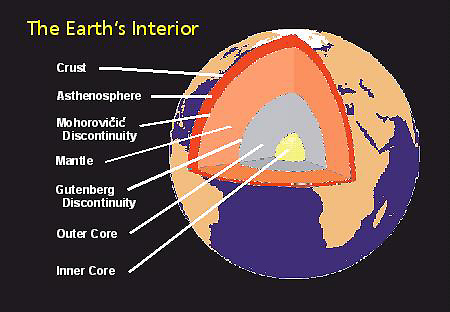
  • Earthquakes are the phenomena experienced during sudden movements of the Earth's crust. Under the Earth's crust lies the asthenosphere, the upper part of the mantle composed of liquid rock. 
  • The plates of the Earth's crust essentially "float" on top of this layer, and can be forced to shift as the upwelling molten material below moves. As the plates shift (and thus interact with each other), an enormous amount of energy is released in the form of waves. 
  • Although they can occur anywhere on the planet with little or no warning, the most extreme earthquakes occur near plate boundaries, as the plates converge (collide), diverge (move away from another), or shear (grind past one another). Moving rock and magma within volcanoes can also trigger earthquakes. 
  • In all of these cases, large sections of the crust can fracture and move to-and-fro to dissipate the released energy. 
  • This "shaking" is the sensation felt during an earthquake. The energy released is often described in terms of "magnitude," a logarithmic scale used to describe how energetic an earthquake was; a quake of magnitude 2 is hardly noticeable without special monitoring equipment, while quakes over magnitude 8 may actually cause the ground to visibly heave and roll.
  •  Since the scale is logarithmic, a magnitude 8 quake is not four times more energetic than a magnitude 2 quake, but one billion times more energetic

What Is "Induction Cooking"?


Induction Cooking:
How It Works

What Is "Induction Cooking"?


Here's the Basic Idea

"Cooking" is the application of heat to food. Indoor cooking is almost entirely done either in an oven or on a cooktop of some sort, though occasionally a grill or griddle is used.
Cooktops--which may be part of a range/oven combination or independent built-in units (and which are known outside the U.S.A. as "hobs")--are commonly considered to be broadly divided into gas and electric types, but that is an unfortunate oversimplification.
In reality, there are several very different methods of "electric" heating, which have little in common save that their energy input is electricity. Such methods include, among others, coil elements (the most common and familiar kind of "electric" cooker), halogen heaters, and induction. Further complicating the issue is the sad habit of referring to several very different kinds of electric cookers collectively as "smoothtops," even though there can be wildly different heat sources under those smooth, glassy tops.
As we said, cooking is the application of heat to food. Food being prepared in the home is very rarely if ever cooked on a rangetop except in or on a cooking vessel of some sort--pot, pan, whatever. Thus, the job of the cooker is not to heat the food but to heat the cooking vessel--which in turn heats and cooks the food. That not only allows the convenient holding of the food--which may be a liquid--it also allows, when we want it, a more gradual or more uniform application of heat to the food by proper design of the cooking vessel.

Cooking has therefore always consisted in generating substantial heat in a way and place that makes it easy to transfer most of that heat to a conveniently placed cooking vessel. Starting from the open fire, mankind has evolved many ways to generate such heat. The two basic methods in modern times have been the chemical and the electrical: one either burns some combustible substance--such as wood, coal, or gas--or one runs an electrical current through a resistance element (that, for instance, is how toasters work), whether in a "coil" or, more recently, inside a halogen-filled bulb.

How Induction Cooking Works:

  1. The element's electronics power a coil (the red lines) that produces a high-frequency electromagnetic field (represented by the orange lines).
  2. That field penetrates the metal of the ferrous (magnetic-material) cooking vessel and sets up a circulating electric current, which generates heat. (But see the note below.)
  3. The heat generated in the cooking vessel is transferred to the vessel's contents.
  4. Nothing outside the vessel is affected by the field--as soon as the vessel is removed from the element, or the element turned off, heat generation stops.

    There is thus one point about induction: with current technology, induction cookers require thatall your countertop cooking vessels be of a "ferrous" metal (one, such as iron, that will readily sustain a magnetic field). Materials like aluminum, copper, and pyrex are not usable on an induction cooker. But all that means is that you need iron or steel pots and pans. And that is no drawback in absolute terms, for it includes the best kinds of cookware in the world--every top line is full of cookware of all sizes and shapes suitable for use on induction cookers (and virtually all of the lines will boast of it, because induction is so popular with discerning cooks). Nor do you have to go to top-of-the-line names like All-Clad or Le Creuset, for many very reasonably priced cookware lines are also perfectly suited for induction cooking. But if you are considering induction and have a lot invested, literally or emotionally, in non-ferrous cookware, you do need to know the fact


    So How Much Power Is What?


    Perhaps the most useful way to use that conversion datum is to see what good gas-cooker BTU values are and work back to what induction-cooker kW values would have to be to correspond. But what are good gas-cooker BTU values? Here too, opinions will vary. As a sort of baseline, we can look at what typical mid-line gas ranges look like. As numerous sources report, a typical "ordinary" home gas range will usually have its burners in these power ranges, give or take only a little: a small burner of about 5,000 Btu/hour; two medium-level burners of about 9,000 Btu/hour; and (depending on width, 30 inches or 36 inches) either one or two large burners of anywhere from 12,000 to 16,000 BTU/hour

    as four 15,000-BTU/hour burners and two 18,000-BTU/hour burners). One expert source remarked of such gear: Most commercial-style home ranges offer 15,000 BTUs per burner, which is perfectly adequate for most at-home cooks. You won't always need all that heat, but if you want to caramelize a bell pepper in seconds, or blacken a redfish like a pro, well, you'll need all the heat you can get. My advice: Go for the big-time BTUs (which, in the tests he was discussing, was that 18,000 BTU/hour level).
    So let's summarize by showing representative gas-power levels and their induction-power equivalents (remember, calculated quite conservatively):
    • Typical home stove:
      • small: 5,000 BTU/hour gas = 0.70 kW induction
      • medium: 9,000 BTU/hour gas = 1.25 kW induction
      • large: 12,000 BTU/hour gas = 1.70 kW induction; or 15,000 BTU/hour gas = 2.10 kW induction
    • Typical "pro style" stove:
      • medium: 15,000 BTU/hour gas = 2.10 kW induction
      • large: 18,000 BTU/hour gas = 2.50 kW induction
    (Even for wok cooking, the most power-hungry kind there is, experts consider 10,000 BTU/hour good and 12,000 BTU/hour "hot".)
    So how do actual real-world, on-the-market induction cooktops stack up against gas?
    It's an almost comic mismatch. Sticking to build-in units (as opposed to little free-standing countertop convenience units), it is difficult, perhaps by now impossible, to find a unit with any element having less than 1.2 kW power--which puts the smallest induction element to be found equal to the average "medium" burner on a gas stove. The least-expensive 30-inch (four-element) induction cooktop has:
    • a 1.3-kW small element (between 9,000 and 9,500 BTU/hour),
    • two elements of 1.85 kW each (well over 13,000 BTU/hour), and
    • one element of 2.4 kW (over 17,000 BTU/hour).
    The least-expensive 36-inch (five-element) induction cooktop has:
    • a 1.2-kW small element (8,500 BTU/hour),
    • a medium element of 1.8 kW (13,000 BTU/hour),
    • a larger element of 2.2 kW (16,000 BTU/hour),
    • and two elements of 2.4 kW (over 17,000 BTU/hour).
    The very highest-power gas burner to be found in the residential market is 22,000 BTU/hour, and that's a sort of freak monster, whereas a 3.6-kW and 3.7-kW element--which is around 26,000 BTU/hour of gas!--is found in many induction cooktops. (Moreover, the elements on some induction units can share power with one another, so that if not every element is already in use, a given one can be "boosted" beyond its normal power level, for uses such as bringing a large pot of water to a boil, or pre-heating a fry skillet.)
    So, in sum, induction is not "as powerful as gas"--it's miles ahead.